
Crafting your proposal: From shared context to clear decision
Your care team has developed a shared perspective on where to focus treatments for your architecture hot spots. Now you need to craft that into a clear and compelling message for decision making.
As reminder, we're at step four in our process. You've already:
☑ Established common context
☑ Aligned on high level goals
☑ Ideated and vetted courses of action
And now you'll prepare your proposal.
So how do you do that?
You shift to storyteller and facilitator. (Not salesperson.)
To do this, I want you to move through these phases, iteratively if needed:
- Composing your hypothesis
- Bringing clarity to the decision on the table
- Crafting your presentation for what the moment needs
- And finally, record the story and decision as shared context for future work
Let's begin with the elements of your story – your hypothesis!
What you believe and why: A hypotheses canvas
You may have noticed the trend of applying hypothesis thinking to product and engineering. I certainly did, and I thought, "why not architecture?!"
Hypothesis thinking and tools bring us back to the scientific method. They put us in a mindset to assert what we think, why, the potential impact, and how we will test if our ideas prove themselves out. (They also provide us an exit ramp to shift to new strategies when they don't.)
This approach short-circuits some of the most common failure modes in strategic architecture work:
- Proposals without enough back story and aren't compelling
- Different understandings on what the strategy actually is (elephant parable)
- Bias and personality who are absolutely right and steam roll (vs. shared decision making)
- Fear to start because once we're in we're in (assuming we have to bite the whole apple)
- Fear to stop because once we're in we're in (even if we are not getting good results)
Simply using a hypotheses canvas to gather and communicate your thoughts will shift minds and help you avoid these failure modes.
Let's look at how this comes together for our Strategy hotspot.
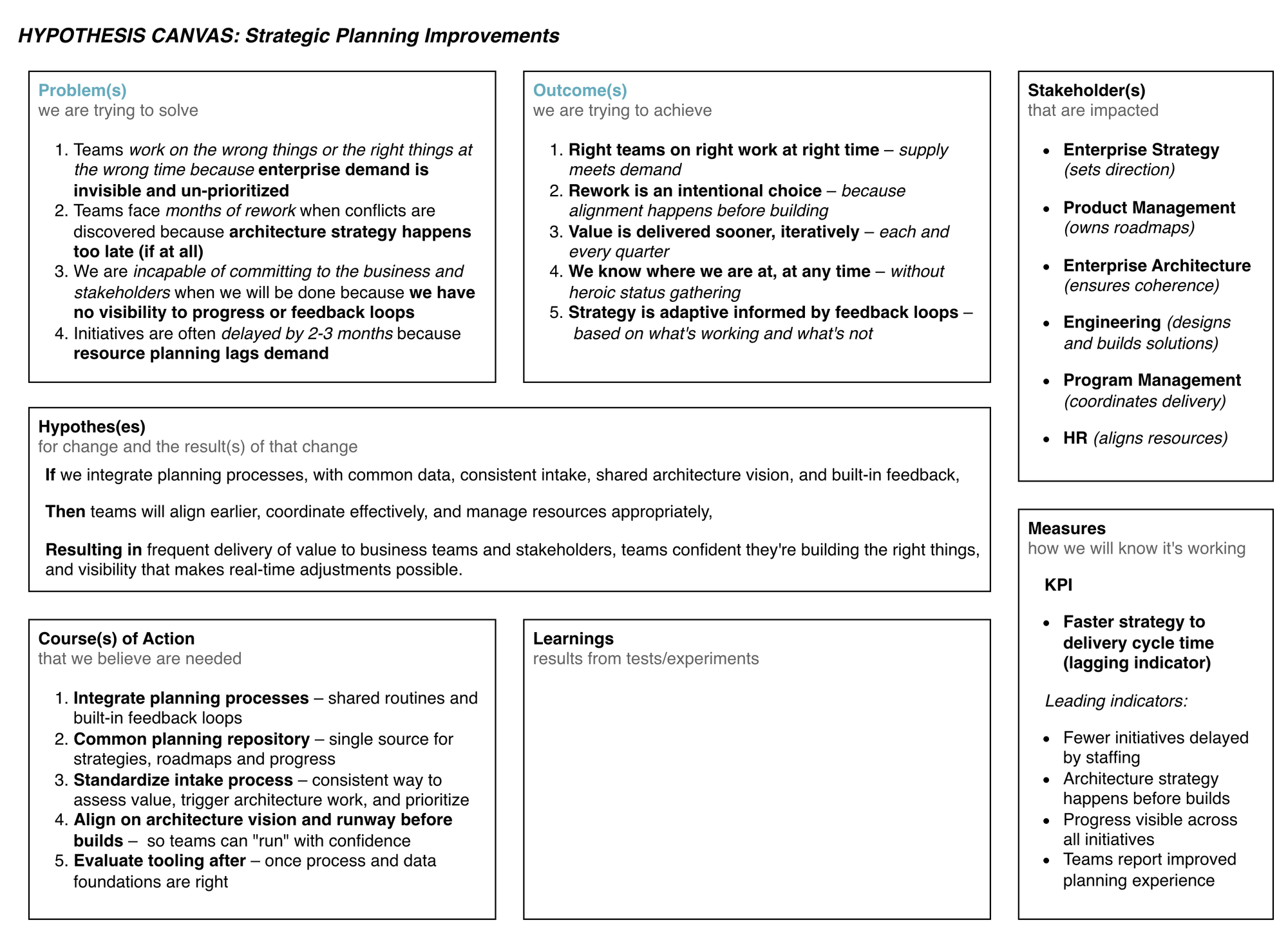
A few things to notice:
The problems and outcomes tie back to what the care team identified in the value stream work and why it matters, while Stakeholders enumerates all of the teams that will play a role in the work and future solutions.
The hypothesis follows an "If... then... resulting in..." structure that makes it testable. We're not just saying "we should do this" - we're saying "if we do X, then Y will happen, resulting in Z."
Courses of action explicitly state the work that needs to be explored, including any logical sequencing. In this case, process and data foundations work should be explored first, then evaluate tooling. This came directly from the care team's insight that technology shouldn't lead the solution.
Measures are directional, not prescriptive. At this stage, we're proposing what success looks like, not committing to specific targets we'd need baselines to set.
Learnings stays empty for now - this section will capture what we discover as we test the hypothesis in future phases.
This is V1 of your hypothesis canvas. You should be coming back to it whenever you learn more and it needs adjusting. You may even learn you disproved your hypothesis in the process. That is the scientific method in action!
Don't forget to review this with your care team before presenting – make sure everyone's aligned on what the one-pager says.
The decision, at this moment in the process: Do we continue?
At this point you need one more thing to facilitate decision making: the decision itself.
Grounding everyone with the architecture flywheel will help right size and align the decision being made, today.
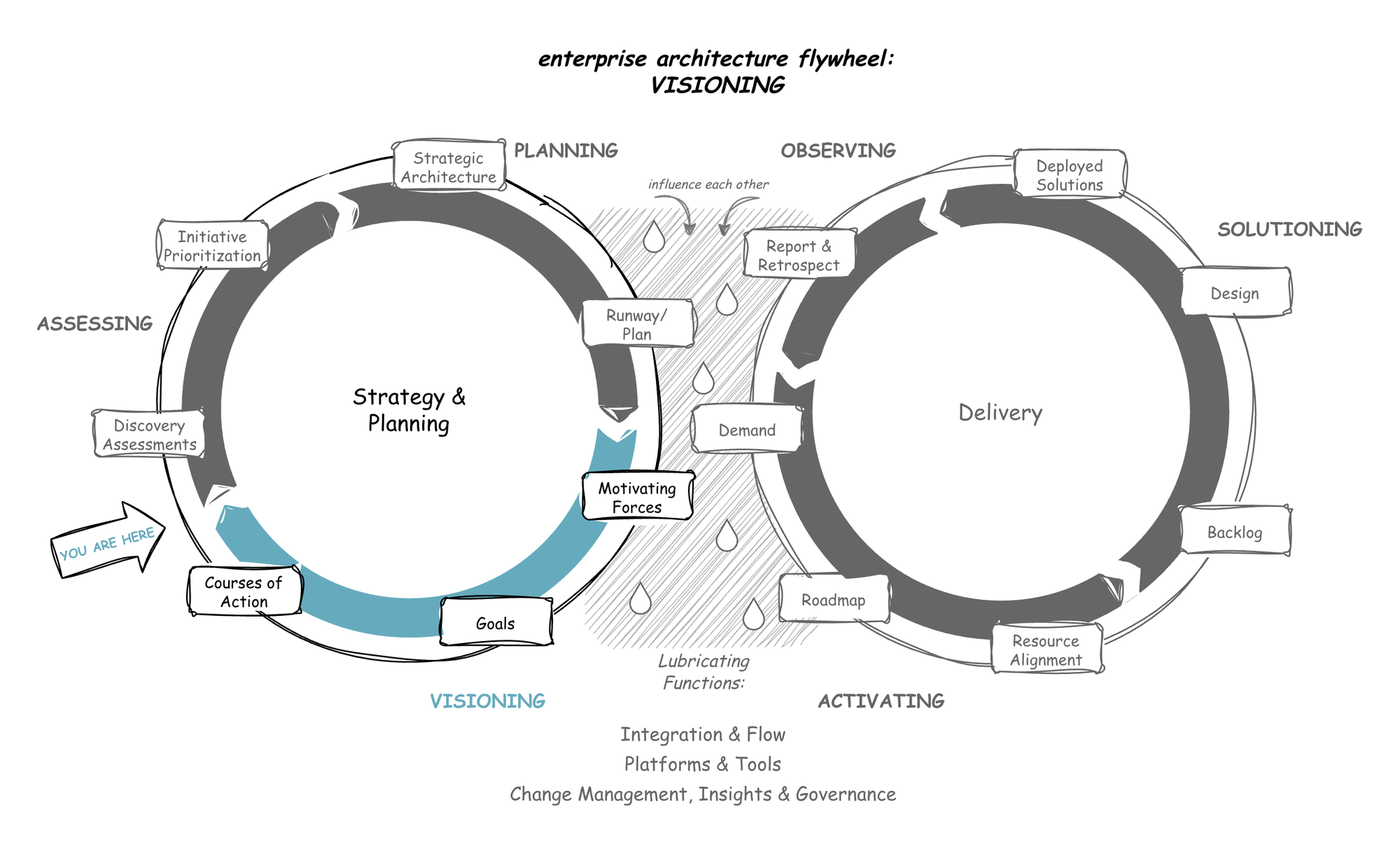
You aren't asking for multi-year funding and organizational commitment to see it through.
You are asking:
Is this worth investing in more exploration compared to everything else we have going on right now?
If you don't make this clear, upfront, people will make assumptions about what you are asking them to commit to do based on their own motivations – which can run the gamut of "kill it", indifference, and "let's go!".
This will easily pollute and confuse the conversation.
Be unambiguously overt on what you are asking them to decide.
Craft your presentation: Meet the moment
Meeting people where they are at to bring them along is an incredibly important part of this process. It's also equally important to edit down what you present for what the moment needs.
This will be hard. Really hard.
Because it is natural to want to share everything you have done up until this point to the lowest level of exquisite detail.
If you don't resist, you will often torpedo the process (and the cause).
Take a deep breath, and if you adopt these tips, you will be fine.
- See yourself as a helper. You are helping the group to make a well informed decision. Remember, you are proposing a care plan to a group of people that want to help the patient.
- Consider your audience. Adjust your content – including level of detail – accordingly. Ruthelessly move slides to the appendix or remove them entirely. Less is often more, especially when you are trying to foster a dialog to make a decision.
- Get feedback. Run through it with people you trust to give you an honest opinion. Use their experience to adjust flow and slide builds.
- This is a muscle. You will get better with reps!
Tradeoffs: No doesn't mean never
Architecture is the art of tradeoffs.
What makes sense today may not make sense a year from now. And as we saw in the triaging exercise, we can't afford to try to fix it all at once.
There are 2 outcomes you should be prepared for.
- This work moves to Assessment and you keep going
- It doesn't
2 isn't a failure. It's the right answer for now. Fast forward to the future, you will find one of these to be true:
- You put something "on the shelf" that can easily be pulled off to continue writing later
- It never is important enough in the scheme of things to do
- You scattered seeds of change that will organically find ways to make small improvements in the mean time
These are all good outcomes.
Document the shared context
At this point, no matter the outcome, I highly suggest taking some time to consolidate the context and proposals into one living perspective.
It's living because should this work move forward, you will enrich and amend what you started with the care team.
This makes it simple to onboard new teams or people so everyone gets the benefit of the shared context you germinated during context building.
This is not a place to just dump everything.
You are building a source of knowledge that is "right sized" to serve the broadest scope of collaborators. From the business teams that will benefit from the outcomes to engineers that will build it.
Your goal is to provide a frame that speaks to the back story and the future vision that everyone can ground on.
In the next post, we'll move forward into the Assessment phase – doing a deeper dive into understanding the implications of a specific course of action on the enterprise.
Reflection
Before you move on, pause for a moment:
Do you have a compelling, holistic understanding of your hypothesis?
Who is your audience and have you tailored your presentation to what they need?
Are you prepared for this work to not move forward?
References
Have questions or thoughts about this post?
Email me at hello@eaforeveryone.com or connect with me on LinkedIn.