
Triaging your enterprise architecture

Imagine you run a hospital. Your staff doesn't have days or weeks to assess severity, form a hypothesis, and decide who needs immediate attention. They work with incomplete information, rely on experience, and trust they can adjust as they learn more.
Your enterprise architecture needs the same approach.
You can't wait for perfect information, and you can't tend to everything all at the same time. You need to efficiently assess:
- What's working
- What's not
- Where to focus your limited resources
You've seen the flywheel. Now let's put it to work.
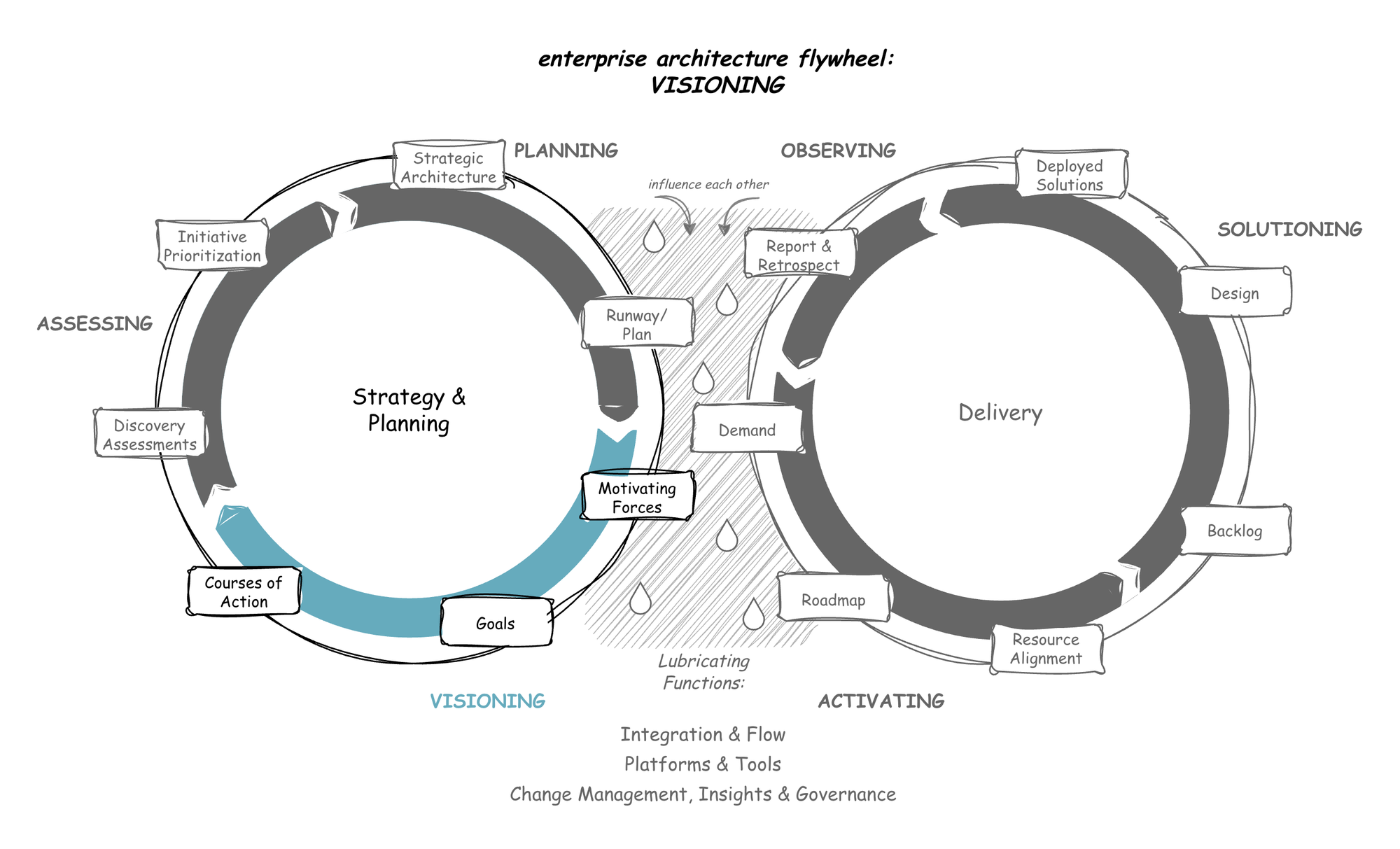
This series is all about establishing a Strategy and that begins with Visioning. Specifically, we'll triage your architecture to find the hotspots that deserve deeper attention, today.
Just like patient triage, the goal is to form quick hypotheses about where to do further investigation, not to diagnose everything perfectly on the first pass. Quick assessments based on the most significant motivational forces will help you narrow in towards critical goals and potential courses of action.
This is part of the routine you'll repeat periodically in your architecture rhythm. For now, let's walk through it step by step.
Rally the staff
For this activity, you will want a diverse set of perspectives from across your teams.
For each altitude, think about who can speak to what's happening there:
- Strategy: Someone who understands business priorities, direction, and how goals get translated into cross-enterprise solutions
- Integration & Flow: Someone who sees how work orchestrates between functional areas and teams
- Delivery: Someone in the trenches building and shipping
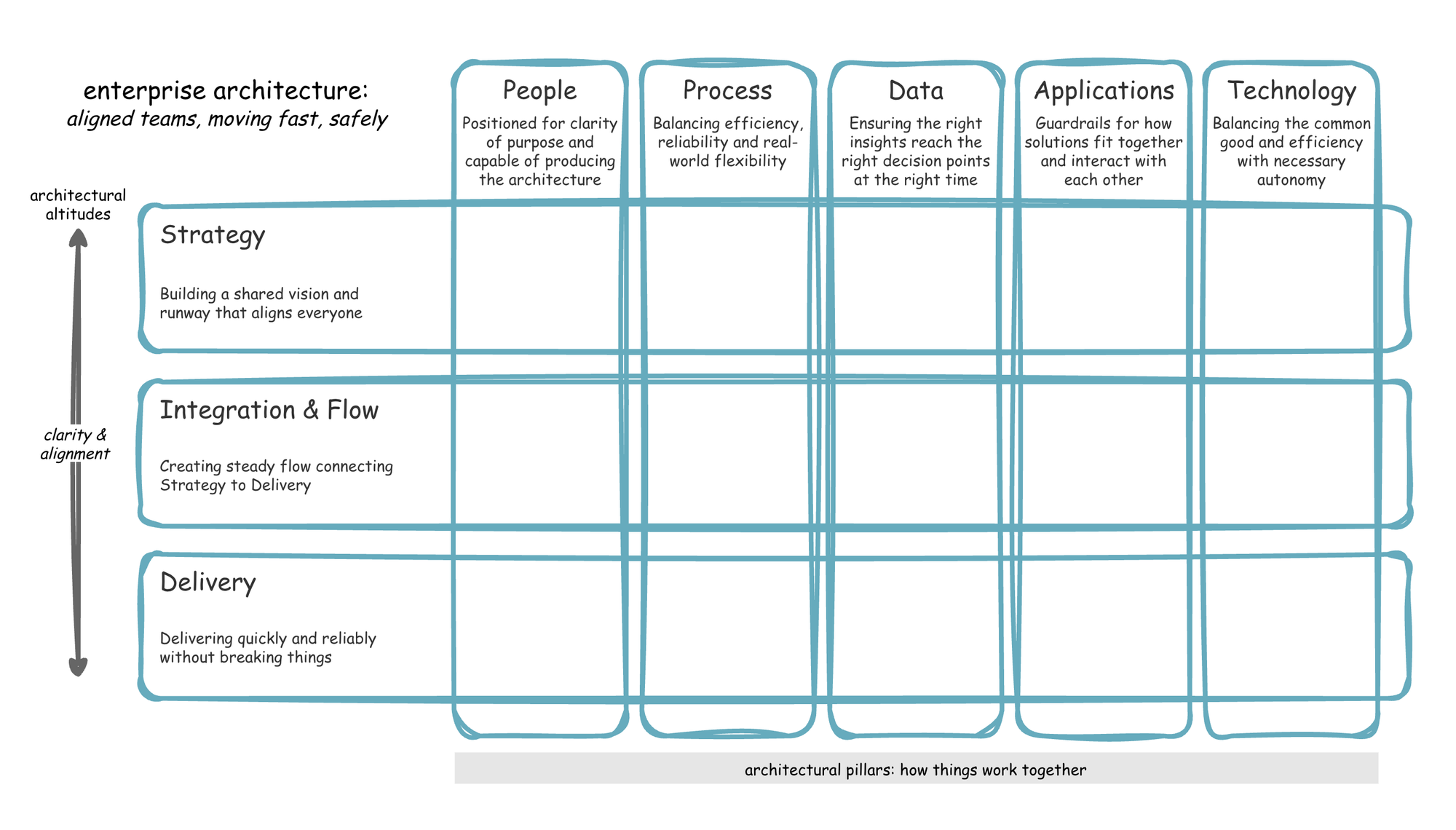
And across pillars, you need perspectives on People decisions, Process consistency, Data trustworthiness, Applications integration, and Technology infrastructure.
You might have one person who can speak to multiple dimensions. That's fine. The goal is coverage, not one person per box.
In fact, anything more than 8-10 people will degrade the efficiency of this process. Remember, you are forming a hypothesis. Your subject matter experts, like specialists in a hospital, will be called in when needed later.
Embrace ambiguity: Assessing based on what's at hand, now
Just as hospital staff rely on vital signs and visual assessment – not waiting for lab results to begin care – your team should assess based on what they know right now.
You will want a common rubric, even if there is some subjectivity. If your team already adopts something like CMMI maturity levels, great – use those.
If not, keep it simple, like a subjective but directionally correct pain scale.
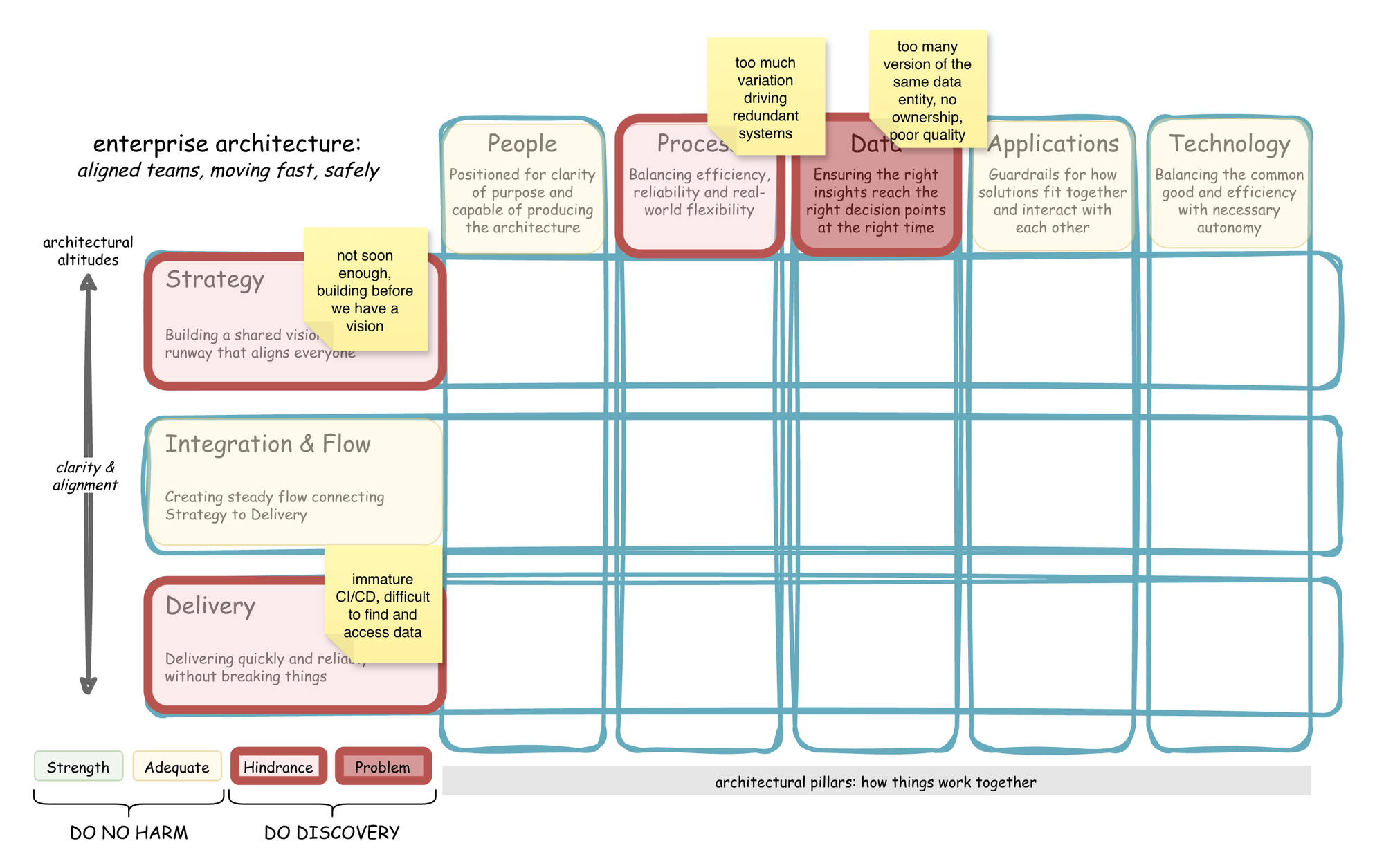
Strength: Accelerates our work and the organization
Adequate: No major issues, doing its job
Hindrance: Slowing teams down, creating friction
Problem: On fire, actively causing failures
We are looking for the architecture dimensions with the greatest pain.
Just as a patient presenting with a head injury immediately signals:
- The motivational forces demanding your focus (head injury)
- The ideal outcomes or goals (stop the bleeding)
- Potential courses of action depending on the nature of the wound (bandage, stitches, surgery)
Your "Problem" and "Hindrance" ratings reveal what should demand your attention, first, why, and guide logical next steps.
Send your staff out with their clipboards
Give your staff a simple template - a spreadsheet, a Miro board, even a printed placemat. Whatever works for your culture.
Each person should:
- Rate each dimension they can speak to (Strength | Adequate | Hindrance | Problem)
- Add 1-2 comments explaining why
- Spend no more than 30-60 minutes total
A fast but directionally correct assessment matters more than perfection here.
Gather your staff
Once your staff has had time for their individual assessments, now is the time to bring them together to compare notes and decide where to focus next.
Every person should get the floor to describe what they think and why. No judgment, we're all here to help.
Once everyone has shared, look for patterns. Where do multiple people see the same hotspot? Those are your high-confidence areas for where to focus next.
Now comes the hard part: pick no more than 3 areas to dig deeper into.
Why only 3?
Because:
- Discovery takes time and focus
- Human beings make better decisions with less choice
- If you try to fix everything at once, you'll fix nothing
If everything feels urgent, ask: which 3 would unlock the most progress if solved?
For each hotspot:
- Assign a captain — ideally someone who can facilitate collaboration, not just drive toward their own solution
- Set a review date — agree on when you will reconvene, preventing perpetual analysis
This keeps your patients from suffering unnecessarily while waiting for answers.
Triaging drives the next step
At this point, a diverse set of staff has collaborated to triage your patients to figure out where to focus your resources. Like in a hospital, you are not prioritizing the relatively healthy patients. You are prioritizing those with the greatest risk.
You don't have all the answers – but you have a clear direction.
In the next post, we'll go deeper: how to diagnose and form testable hypotheses to alleviate the problems you've identified.
Reflection
Before you move on, pause for a moment:
Who in your organization could represent each altitude and pillar?
What's preventing you from running this exercise right now?
If you did this today, which dimension do you think would be "on fire"?
References
Have questions or thoughts about this post?
Email me at hello@eaforeveryone.com or connect with me on LinkedIn.